Posted Monday, August 31, 2026
1moA somewhat old poem
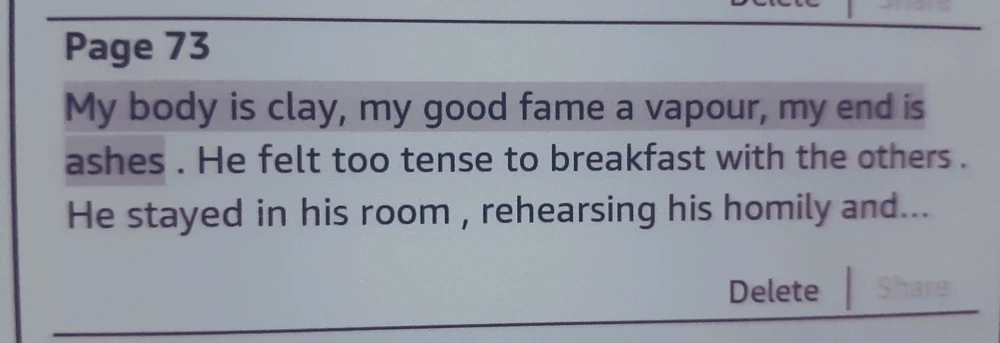
There are very few books I can return to again and again without ever feeling that I've truly finished them. Conclave by Robert Harris is one of those books. I'm currently reading it for the fifth time, and somehow, each time I return to it, I find something I hadn't noticed before—a different question, a different silence, a different piece of humanity hiding between its pages. At some point, I loved the book enough that simply reading it wasn't enough anymore, so I wrote a poem inspired by it. And this is that poem. I hope you enjoy reading it as much as I enjoyed writing it. XD “Ashes Beneath the Altar” “My body is clay, my good fame a vapour, my end is ashes.” Tonight, I kneel before the silence, and I wonder— what is a man when the body he carries is only borrowed earth? What is a name when the mouth that praises it will one day become dust? What is glory when even the marble remembers how to crack? I have spent my life building a cathedral out of things that perish: a name, a face, a reputation, the fragile affection of those who promised they would remember me. And yet— what remains of a cathedral when God closes the door and the candles die? My body is clay. I have always known this, but knowledge is a poor companion when mortality finally sits beside you. We dress the clay. We perfume it. We crown it. We teach it to walk proudly beneath the eyes of strangers, as though beauty could negotiate with death. But the grave has never been impressed by beautiful faces. It asks no questions about our clothes, our victories, our sins, or the number of people who once loved us. It simply waits. And perhaps that is the most honest thing about death— it never pretends to be anything else. My good fame a vapour. How strange, that we spend years trying to become unforgettable, only to discover that even memory is mortal. Someone will speak my name after I am gone. Perhaps. And someone else will mispronounce it. Then someone will forget it. Then the last photograph will fade. Then the last person who remembers my voice will close their eyes. And I will become a small silence in a world that does not stop breathing. Tell me, is that tragedy? Or is it mercy? For what is immortality if it means carrying the weight of oneself forever? Sometimes I think God made us fragile so that we might finally understand what cannot be possessed. The body cannot be possessed. Time cannot be possessed. Another human being cannot be possessed. Not even love. We can only receive them. And perhaps the greatest sin is not losing what we love, but believing that because it was given to us, it was promised to remain. Yet there is one thing I cannot surrender so easily. Love. Ah, love— that beautiful rebellion of the mortal heart. Why should I love you when I know that one day your hands will become dust? Why should I memorize your face when time is already working against me? Why should I let your voice become sacred to me when every voice must eventually fall silent? Because perhaps this is what love means: to know the ending and still say, stay. I do not want to immortalize your body. I want to remember the soul that looked through your eyes. I want to remember the small movements you never thought mattered. The pauses in your speech. The way your face changed when you spoke about something you truly loved. The silence between two sentences. The humanity you tried to hide beneath your dignity. These are the things I would carry beyond the grave— if anything in me is permitted to cross it. And perhaps this is where faith begins: not with certainty, but with the trembling question that rises from the heart when everything else has been stripped away: If I am only clay, why does my soul long for eternity? Why does a creature born from dust dream of heaven? Why does the human heart ache for a beauty that no earthly thing can completely satisfy? Why do we mourn as though death has broken something that was never meant to be broken? Perhaps because somewhere beneath the flesh and the fear, we remember that we were made for more than ashes. Still, I am afraid. I confess it. I am afraid of the silence after the final word. Afraid that all my questions will remain unanswered. Afraid that I have spent too much of my life searching for meaning in places that could not contain it. Afraid that I will stand before eternity and discover how little of myself was truly mine. But perhaps even fear can become prayer. Perhaps the trembling heart is not the opposite of faith. Perhaps it is where faith begins. So let the world keep its applause. Let my name become vapour. Let the portraits fade from their frames. Let the statues lose their faces. Let history forget the shape of my hands. If, beneath all of this, I have loved truly, if I have forgiven when vengeance was easier, if I have remained gentle in a world that rewarded cruelty, if I have looked upon another soul and recognized something sacred there— then perhaps the ashes will not be empty. One day, my body will return to the earth from which it came. My hands will hold nothing. My eyes will no longer search for beauty. My voice will no longer speak your name. And my good fame— that little ghost I spent so much time feeding— will vanish like incense beneath an open window. But if there is mercy, if there is something beyond the grave that the heart cannot prove but cannot stop hoping for, then let me carry only this: the love I gave, the love I received, and the quiet knowledge that for a brief moment in the enormous history of creation, I was here. I was afraid. I believed. I loved. And I was loved. Perhaps that is enough for a creature of clay. Perhaps that is enough for ashes. Perhaps— when everything else has become dust— love will be the one prayer God still remembers." — Hecate Mortem Vespera 🦇
Poems Community
The poems community, chat, and discussion.
3.6K SOULS
No comments yet!
Meet New People
50,000,000+
DOWNLOADS